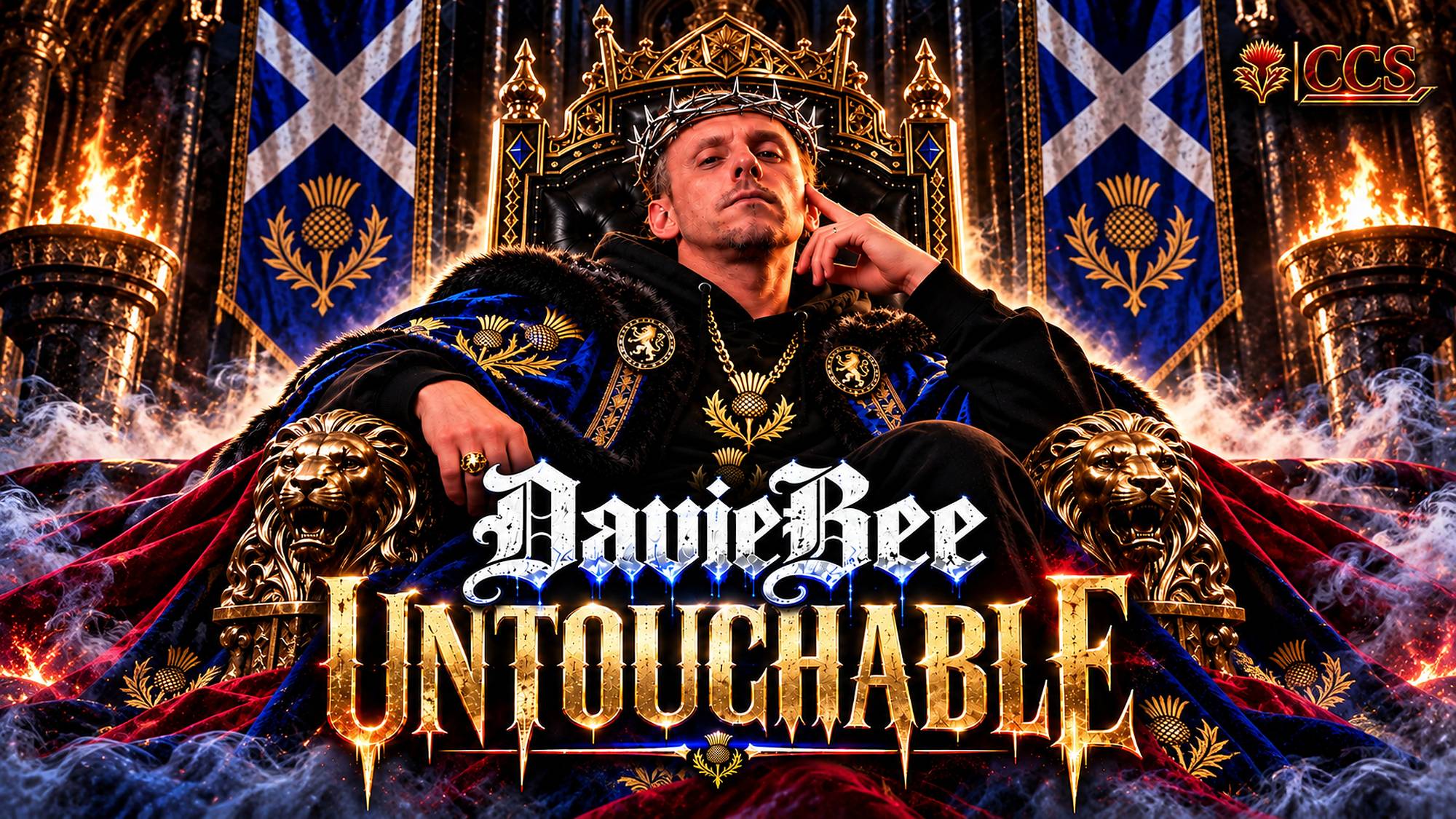
This week we’re heading north of the border to Wishaw in North Lanarkshire, where independent musician and author David Brownlie makes music as DavieBee. He has even come up with his own name for his sound: Lanarkshire Pop-Hop.
It’s a mix of pop and hip-hop with bagpipes, fiddles, hurdy-gurdy, orchestral arrangements, indie guitars and old-school scratching all thrown in, and he raps and sings in his own Scottish accent. His influences run from Take That and Bob Dylan to Tupac, Eminem and Arctic Monkeys, so it’s no surprise he doesn’t want to be boxed in.
David is also building his own media business, ClydeCast Studios, from the ground up with no investors and no team behind him. His debut single “Untouchable” is due out on 1 November 2026. We caught up with him to find out more.
Tell us a little bit about yourself?
I’m David Brownlie, an independent Scottish musician and self-published author from Wishaw in North Lanarkshire, Scotland.
I release my music under the name DavieBee, and I’m also the founder of ClydeCast Studios, an independent media and creative business I’m developing across music, news, sport and commentary.
Creativity has always been an important part of my life. Whether it’s writing books, creating music or developing broadcasting projects, I’ve never wanted to limit myself to one particular area.
One thing I’m particularly proud of is that I’m building everything independently, from the ground up. I don’t have a large team working behind the scenes, outside financial backing or investors funding my ambitions.
That means I’m responsible for the creative work, production, planning, administration and promotion.
It’s certainly not easy, but I believe in what I’m trying to achieve, and I’m determined to keep building it.
At the moment, music is my main focus, although I’m continuing to develop the wider ClydeCast Studios business alongside it.
As a musician, I’m not interested in being restricted to one particular style or following whatever happens to be fashionable. I want the freedom to experiment, express my opinions, tell stories and create music that reflects both my Scottish identity and my own experiences.
DavieBee is my identity as a musician, while ClydeCast Studios represents my wider creative ambitions.
I’m still at the beginning of that journey, but I’m putting in the work to turn those ambitions into something meaningful.
When did you first start to develop a passion for music?
I’ve had a passion for music for as long as I can remember.
In fact, I was only about five years old when I was being made to learn all the lyrics and dance routines to Take That songs! So I suppose you could say my musical education started pretty early, whether I had much choice in the matter or not!
As I got older, that interest never disappeared.
When I was a teenager, I actually tried to pursue music myself, but unfortunately, life got in the way.
Looking back, one of the biggest difficulties was the lack of encouragement and support around me. My friends at the time and even my family weren’t particularly supportive of my musical ambitions.
When you’re young, still trying to find your place in the world, and nobody is really encouraging you to pursue something, it’s very easy for those ambitions to fall by the wayside.
There were practical barriers too.
At that time, getting into music-related college courses wasn’t particularly straightforward, especially if you hadn’t excelled in those subjects at school or didn’t have the right connections.
Even trying to learn and produce music independently at home was difficult because the necessary equipment was considerably more expensive and less accessible than it is today.
Eventually, I put those ambitions aside, although my interest in music never really went away.
Then, during the COVID period, I came across an advertisement for a college in Glasgow encouraging mature students to enrol.
Something about it caught my attention, so I started researching the courses available and eventually applied for a DJ and music production course.
That decision changed quite a lot for me.
For the first time, I had the opportunity to learn properly about music production, work with different digital audio workstations (DAWs), understand professional equipment and gain practical experience in studio environments.
I wasn’t simply sitting at home wondering how everything worked anymore. I was actually learning the technical side of something I’d wanted to pursue since I was younger.
What made the experience even more valuable was the support I received from my lecturer.
After the course finished, he helped me identify and source equipment that would suit my needs and allow me to continue developing my skills independently.
A few months later, I started experimenting with making my own beats and developing my production skills.
Around that time, I was also developing the idea for ClydeCast Studios, initially as a wider creative and media venture.
Then I had something of a lightbulb moment: why couldn’t ClydeCast Studios have its own music division?
I started thinking about all the people out there who might have musical talent or creative ambitions but lack the equipment, technical knowledge, financial resources or encouragement to pursue them.
I knew what it felt like to have an ambition without the support needed to develop it.
That became an important part of my vision for CCS Music.
I want to eventually create opportunities for aspiring and established artists, whether that means access to equipment, studio facilities, practical guidance or simply having someone willing to give them a chance.
And that ambition doesn’t stop at musicians. I’d love ClydeCast Studios to become a place where creators from different backgrounds can develop their ideas and talents.
The creative industries can be difficult to navigate. There are plenty of people who look out only for themselves, and unfortunately, not everyone has an artist’s best interests at heart.
I’d like to build something different, where helping another person succeed is seen as a positive thing rather than a threat or an opportunity to exploit them.
So, while my passion for music started when I was a very young child learning Take That routines, it’s developed into something much bigger than I could have imagined back then.
Music has become both a personal creative outlet and an inspiration for the kind of opportunities I’d eventually like to offer other people.
Which artists did you listen to while growing up?
I grew up listening to a massive variety of music, and I think that’s one of the reasons I’ve never wanted to restrict myself to one particular genre.
My earliest musical memories include Take That, whose lyrics and dance routines I was learning when I was about five years old.
But there was always a wide mixture of music being played around me.
My mum listened to the Bay City Rollers, while my aunties introduced me to artists like Bon Jovi, Simply Red and Toploader, alongside plenty of music from the 1960s onwards.
I also grew up enjoying artists such as Elton John, George Michael, Spandau Ballet and Chicago.
One of my earliest cassettes was a recording of “Knockin’ on Heaven’s Door” associated with Dunblane.
That song eventually led me to discover Bob Dylan, whose music and songwriting I developed a real appreciation for.
As I got older, particularly during my teenage years, I became increasingly interested in British indie and alternative rock.
I listened to bands such as Stereophonics, Arctic Monkeys, Kaiser Chiefs, The Kooks, The Killers, Little Man Tate and Kings of Leon.
I particularly enjoyed that period when British indie music was everywhere. There was something about the energy, songwriting and individuality of those bands that appealed to me.
I also really enjoyed Kings of Leon’s early material, particularly their first album.
But alongside all of that, I was developing a serious interest in hip-hop.
Eminem was a major part of what I listened to growing up, along with 50 Cent, Tupac Shakur, N.W.A. and Lil Wayne.
Tupac particularly stood out to me, not simply because of his music, but because of his willingness to discuss politics, social injustice, personal struggles and subjects that other artists sometimes avoided.
I also developed a strong interest in British rap and hip-hop, listening to artists such as Tinie Tempah, Tinchy Stryder and Giggs.
What appealed to me about British artists was hearing people making music with their own accents, experiences and cultural identities rather than feeling they had to imitate the American music industry.
What I find interesting when I look back is that I never really belonged to one musical camp.
I could quite happily listen to Bob Dylan, then Eminem, Lil Wayne or N.W.A., followed by Arctic Monkeys, George Michael, Tinie Tempah or Bon Jovi.
To me, good music has never been about fitting into a particular genre. It’s about the songwriting, the emotion, the message and whether something connects with you.
That variety has stayed with me, and I think it’s played an important part in shaping how I approach making my own music today.
How would you describe your music to someone who hasn’t heard you before?
The best way I can describe my music is that it’s a mixture of different genres, influences and ideas, brought together under something I’ve created called Lanarkshire Pop-Hop.
I’m an independent Scottish musician, and I’ve never wanted to restrict myself to being described purely as a rapper.
Rap is one element of what I do, but I also incorporate singing, melody, storytelling and different musical arrangements.
The name Lanarkshire Pop-Hop reflects both where I come from and my approach to making music.
It combines elements of pop and hip-hop, but that’s really only the starting point.
I enjoy experimenting with traditional Scottish and Celtic instruments, including bagpipes, fiddles and the hurdy-gurdy, alongside orchestral arrangements, indie influences, electronic sounds and old-school DJ scratching.
I’m constantly listening out for new musical ideas.
I could be out somewhere, hear a particular instrument, rhythm or style of music that catches my attention, and immediately start thinking about how I could incorporate it into Lanarkshire Pop-Hop.
However, I don’t believe in simply throwing instruments into a track for the sake of being different.
Everything has to fit together.
The instruments, the beat, the rhythm and the melody all need to complement one another rather than compete against each other.
For me, it’s about creating something that sounds natural and cohesive, even when I’m combining musical elements that people wouldn’t normally expect to hear together.
One thing I believe in is being open about the tools I use to make my music.
As an independent musician working without outside funding, I currently use Suno AI as part of my creative and production process, particularly to help generate instrumental sounds and arrangements that I don’t have the equipment, musicians or financial resources to record myself.
It’s a practical way of keeping production costs manageable while still allowing me to experiment with the sounds I have in my head.
However, my long-term ambition is to move increasingly towards working with live musicians.
As my music develops and begins generating income, I’d like to hire instrumentalists to perform and record the different parts of my arrangements.
That would not only help bring another dimension to my music but also allow me to create paid opportunities for other musicians, which ties directly into my ambitions for ClydeCast Studios.
I believe artificial intelligence is here to stay, and musicians need to learn how to evolve alongside it rather than simply ignore its existence.
But that doesn’t mean I believe we should use AI for absolutely everything.
There’s a difference between using technology to support creativity and allowing technology to replace creativity altogether.
For me, AI is a tool, not the artist.
The concepts, songwriting, lyrics and creative decisions come from me. I’m the one deciding what I want to say, how I want the music to sound and whether the different elements work together.
I don’t believe in using AI simply because it’s available.
It should serve a genuine purpose, particularly when there’s something I cannot reasonably achieve through the resources available to me.
Ultimately, I want technology to help musicians achieve more, not make musicians unnecessary.
Having studied DJing and music production, I particularly enjoy exploring rhythms, unusual instrument combinations and different ways of arranging a track.
I don’t believe every song needs to follow the same formula.
Lyrically, my music covers quite a broad range of subjects.
Some songs are personal and emotional, dealing with life experiences, relationships and difficult situations.
Others are political, tackling subjects such as injustice, inequality, conflict and the behaviour of people in positions of power.
Then there are tracks where I’m more confrontational, using sharp lyrics, humour, wordplay and musical challenges to express my opinions.
I also enjoy making more upbeat music, including dance-oriented tracks.
One thing that’s particularly important to me is maintaining my Scottish identity.
I don’t want to pretend I’m from somewhere else or feel that I need to imitate an American accent to make music.
I’m from Wishaw, in North Lanarkshire, and that’s part of who I am. I want that identity to come through in my music.
I also don’t believe an artist should have to choose between making something commercially accessible and making something meaningful.
A song can have a catchy melody and still have something important to say.
Ultimately, Lanarkshire Pop-Hop isn’t about forcing every song into one particular sound. It’s about having the creative freedom to bring different musical styles together while maintaining my own identity.
If somebody listens to three or four of my songs, they might hear completely different musical influences in each one, but hopefully they’ll recognise the personality, storytelling and attitude connecting them.
That’s what I want DavieBee to represent: music without unnecessary boundaries, created with individuality, honesty and a distinctly Scottish character.
What music have you recorded and released to date?
I’ve been building a growing catalogue of original music under my artist name, DavieBee, with a number of tracks already available through the ClydeCast Studios YouTube channel.
My music covers quite a broad range of subjects and styles, from political and socially conscious songwriting to more personal material, melodic arrangements and experimental sounds.
However, the release I’m particularly concentrating on at the moment is “Untouchable”, which is intended to be my official debut single.
It’s currently going through the review process with my distributor, RouteNote, and I’m aiming for a release on 1 November 2026, subject to approval.
I chose “Untouchable” as my debut single because I believe it’s a good introduction to who I am as a musician and what I’m trying to achieve with Lanarkshire Pop-Hop.
For me, it’s about establishing my musical identity and introducing listeners to an artist who isn’t interested in being restricted to one particular genre or following somebody else’s formula.
I’ve also been working extensively on my first album, with the initial collection of songs already completed.
However, I’m deliberately taking my time with its release.
I want to give my individual singles an opportunity to reach people rather than release everything at once and risk overwhelming listeners.
I’m still developing other material and experimenting with different musical directions, but right now my priority is introducing people to DavieBee and building an audience organically.
“Untouchable” is where I want that journey to begin.
Which artists do you enjoy listening to at the moment – and do they influence your work?
At the moment, I wouldn’t say there’s one particular artist I’m listening to regularly or drawing inspiration from.
For the past three or four weeks, I’ve been concentrating heavily on creating my own music, developing new songs and getting everything organised for my upcoming releases.
It’s taken up so much of my time that I haven’t really had much opportunity to sit down and listen to other artists.
That doesn’t mean I’ve stopped following music, though.
I still keep an eye on artists I’ve listened to over the years. I’ll occasionally visit their YouTube channels to see whether they’ve released anything new.
I’m also quite spontaneous when it comes to discovering music.
Sometimes an interesting song title or thumbnail catches my attention, so I’ll click on it.
Other times, YouTube will automatically play something I’ve never heard before, and I’ll give it a listen.
What usually catches my attention first is the music itself.
If I hear an interesting beat, instrumental arrangement or particular sound, I’m much more likely to give the song a chance.
If something interests me musically, I might take inspiration from an element of it and consider how I could approach something similar within my own style.
However, I try to avoid deliberately listening to other artists specifically to find ideas for my own songs.
I think there’s a danger that if you constantly look towards somebody else’s music for inspiration, you can gradually start sounding too much like the artists you’re listening to.
That’s something I want to avoid.
My biggest influences as a songwriter aren’t necessarily other musicians. They’re real-world events, personal experiences and things happening around me.
I can watch something on the news, come across a story online or hear somebody expressing an opinion, and that might spark an idea for an entire song.
Sometimes the inspiration comes from something completely unexpected.
For example, I’ve always enjoyed looking back at some of the famous lyrical confrontations in hip-hop.
I find the creativity, wordplay and competitive nature of those exchanges fascinating.
I was revisiting some of the exchanges involving Eminem and Machine Gun Kelly when I decided, purely for a bit of fun, to write my own confrontational track.
It started as a playful exercise in songwriting, but I found myself enjoying the creative process.
Around that time, I also came across an AI-based rap project that made me question how artificial intelligence was being used within the music industry.
It wasn’t something that influenced my musical style, but it did reinforce some of my concerns about the direction certain aspects of the industry are taking.
As I’ve mentioned, I’m not against AI. I use Suno as a production tool myself, particularly when I need access to instrumental sounds or arrangements that I currently lack the resources to record with musicians.
However, I believe there’s a difference between using AI to support your creativity and using it in ways that undermine the creative process itself.
That experience also helped inspire some of my more confrontational songwriting.
It coincided with a wider decision about where I wanted to concentrate my energy.
Although I’m continuing to develop ClydeCast Studios across its different areas, I’ve decided that music should be my main priority for the time being.
As the business grows and I hopefully secure more resources, I’d like to bring other people on board to help develop the sports, news and broadcasting sides of ClydeCast Studios.
For now, though, I’m enjoying having the freedom to concentrate on songwriting, experimenting with different sounds and developing my identity as DavieBee.
Ultimately, I don’t want to become a copy of another artist. I’d rather take inspiration from the world around me and use music to express my own thoughts, ideas and experiences.
Who would your dream collaboration be with?
That’s actually quite a difficult question because there are so many talented musicians I’d love to work with.
I think I’d have to give two answers: one musician who’s sadly no longer with us and another collaboration that could still happen.
My first choice would be George Harrison.
What fascinates me about Harrison is that he wasn’t afraid to explore music beyond the traditional boundaries of rock and pop.
His interest in different musical cultures, particularly Indian music and instrumentation, is something I find fascinating.
His guitar playing is another reason he stands out to me.
I’ve always thought he was a fantastic guitarist. His playing had a precision and fluency that felt incredibly intuitive, and he had a remarkable ability to make complex musical ideas sound effortless.
That’s an approach I can relate to with Lanarkshire Pop-Hop.
I enjoy taking instruments and sounds that wouldn’t normally be associated with one another and finding ways to make them work together.
I’d love to imagine what we could create by combining his musical approach with my own ideas, perhaps bringing together Scottish and Celtic instrumentation, Eastern influences and modern production.
For a collaboration that could still happen, I’d choose the Wu-Tang Clan.
One of the biggest reasons is their longevity within hip-hop and the wider music industry.
When you look at groups of that size, particularly ones made up of so many strong individual personalities, it’s remarkable how difficult it can be to maintain that collective identity over several decades.
Members of Wu-Tang Clan have pursued their own solo careers and individual projects, but they’ve continued to maintain their identity as Wu-Tang.
That’s something I really admire.
What I also find interesting is their ability to return to making music together without it feeling as though they’re simply trying to recreate the past.
Some artists return after years away and struggle to reconnect with audiences, but Wu-Tang have managed to maintain a distinctive identity while continuing to evolve.
For me, there’s something fascinating about that.
They’ve been part of hip-hop for more than three decades, which is practically my entire lifetime.
I’d love the opportunity to bring my distinctly Scottish approach to music into a collaboration with them.
The idea of combining their production styles, lyrical approaches and musical personalities with the unusual instrumentation and melodic elements I use in Lanarkshire Pop-Hop would be an incredible creative challenge.
What makes these two choices particularly interesting is just how different they are.
George Harrison and the Wu-Tang Clan might seem worlds apart musically, but that’s exactly what appeals to me.
I don’t believe the most interesting collaborations necessarily come from musicians who already sound alike. Sometimes the best ideas come from bringing completely different musical perspectives together and discovering something neither artist would have created independently.
That’s really what Lanarkshire Pop-Hop is about.
What are your plans for the future?
My first priority is to keep making and releasing music as DavieBee, developing Lanarkshire Pop-Hop and building an audience.
Naturally, I’d love to have a number-one single or album someday, and whenever I’m creating something, that ambition is always there. I want every song to be the best it can possibly be.
However, I’m realistic about how difficult chart success is, especially as an independent musician.
If just one person chooses to buy my single or any of my music, I’d consider that a success.
It means somebody appreciates what I’ve created enough to spend their own money supporting it, and that’s something I’d never take for granted.
I’m doing this because it’s something I’ve wanted to do since I was young, and at 37, I’m finally in a position to pursue it.
I also want to build ClydeCast Studios into a genuinely independent creative space where musicians, songwriters, producers, videographers and other creatives who might face barriers can access equipment, facilities and practical support without corporate gatekeeping or strings attached.
It wouldn’t be about making people my employees.
It would be about opening doors, collaboration and opportunity.
I’d like to help people of all ages and backgrounds, whether they’re just starting out or have spent years wanting to pursue a creative ambition without having the opportunity.
I know from personal experience how difficult it can be to get started when you lack the necessary resources or support.
I want to demonstrate that not everyone working in the creative industries is interested in controlling access or protecting their own position.
Some of us genuinely want to help other people succeed.
And even when I’m able to do that, I’ll still be making my own music.
I have absolutely no intention of giving up songwriting, experimenting with different sounds or releasing music as DavieBee.
The two ambitions go hand in hand.
If I can continue developing my own music while helping other people achieve things they never thought possible, I’ll consider that a far greater success than any chart position.
Follow DavieBee
- YouTube: ClydeCast Studios
- TikTok: @daviebee.ccs